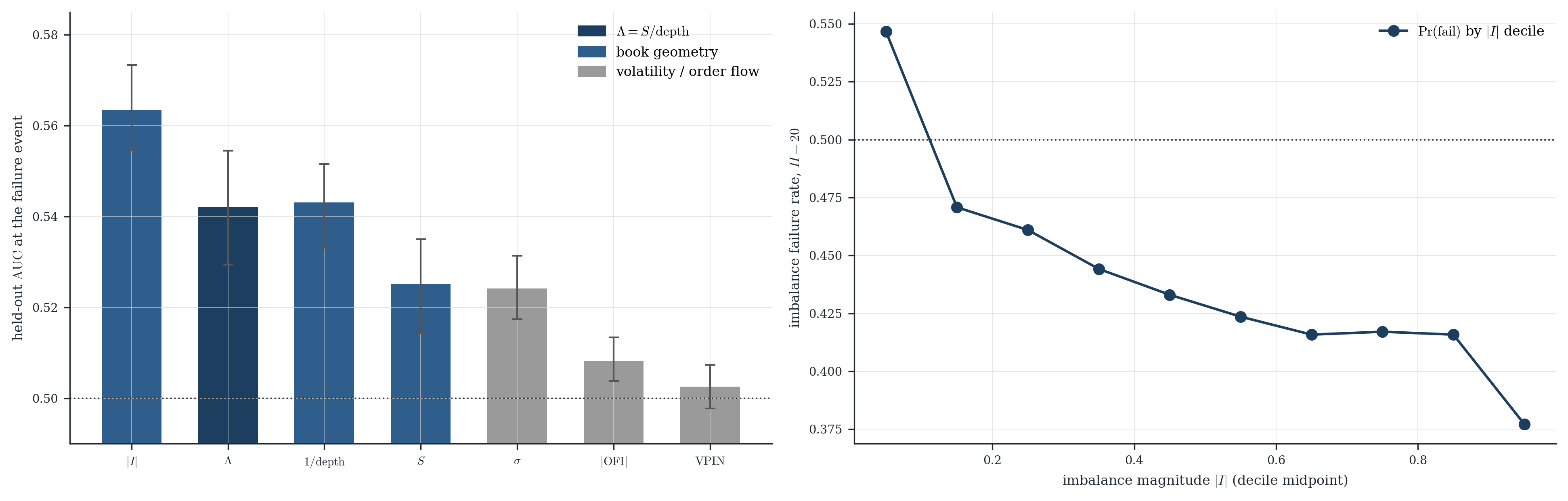
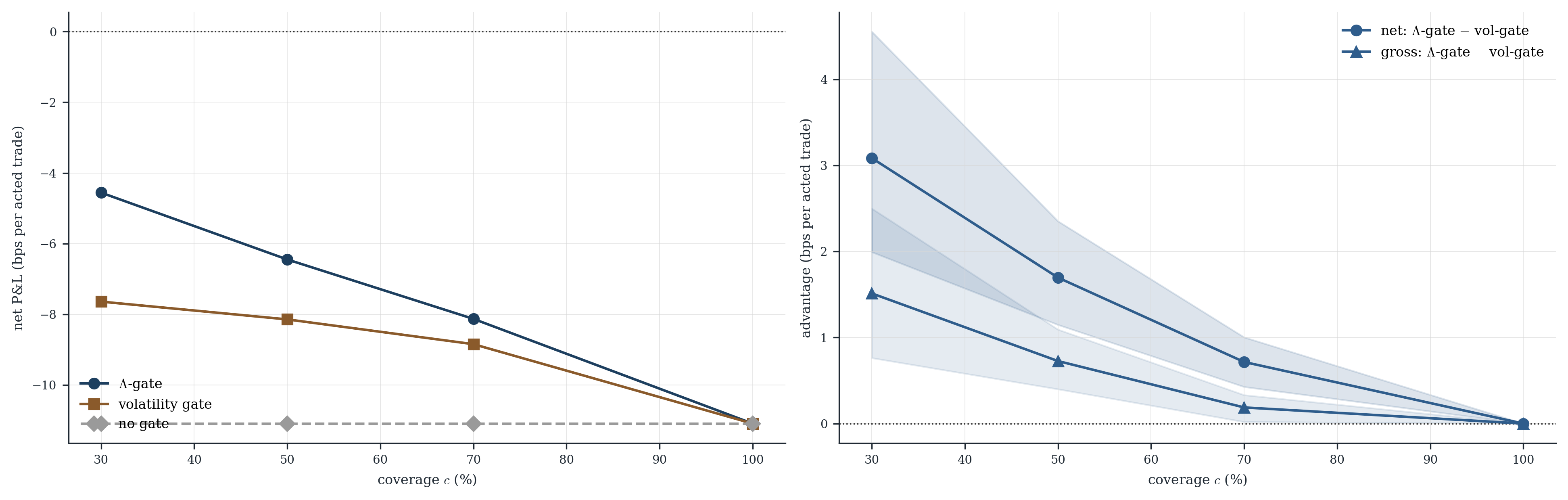
Order-book imbalance is one of the most widely used short-horizon directional signals, yet its reliability is state-dependent. We show it can be forecast in real time from the book itself. On the full cross-section of the Qatar Stock Exchange (216 sessions, about 40 instruments), we define signal failure as the imbalance sign disagreeing with the next mid-price move. A simple book-side ratio, relative spread over depth, detects impending failure better than realised volatility at every horizon, while order-flow toxicity (VPIN, order-flow imbalance) and classical illiquidity measures (Amihud, Kyle's lambda, effective spread) sit at chance. Used as an abstention gate, it raises acted directional accuracy from 0.556 to 0.601 at 30% coverage and beats a volatility gate at every coverage, in accuracy and cost-aware terms alike. The evidence is deep rather than broad: one venue studied exhaustively, with corroborating crypto patterns. A signal-to-noise decomposition explains it: the signal fails in balanced books by construction, volatility measures the sum of signal and noise rather than their ratio, and flow toxicity targets the wrong axis. The ratio costs nothing to compute from top-of-book data, giving execution and risk systems a real-time gauge of when to trust the book.
the fragility ratio: relative spread S over best-quote depth ν
p(s)=Pr[signX=signIs]=21+2∣I∣γ(s)
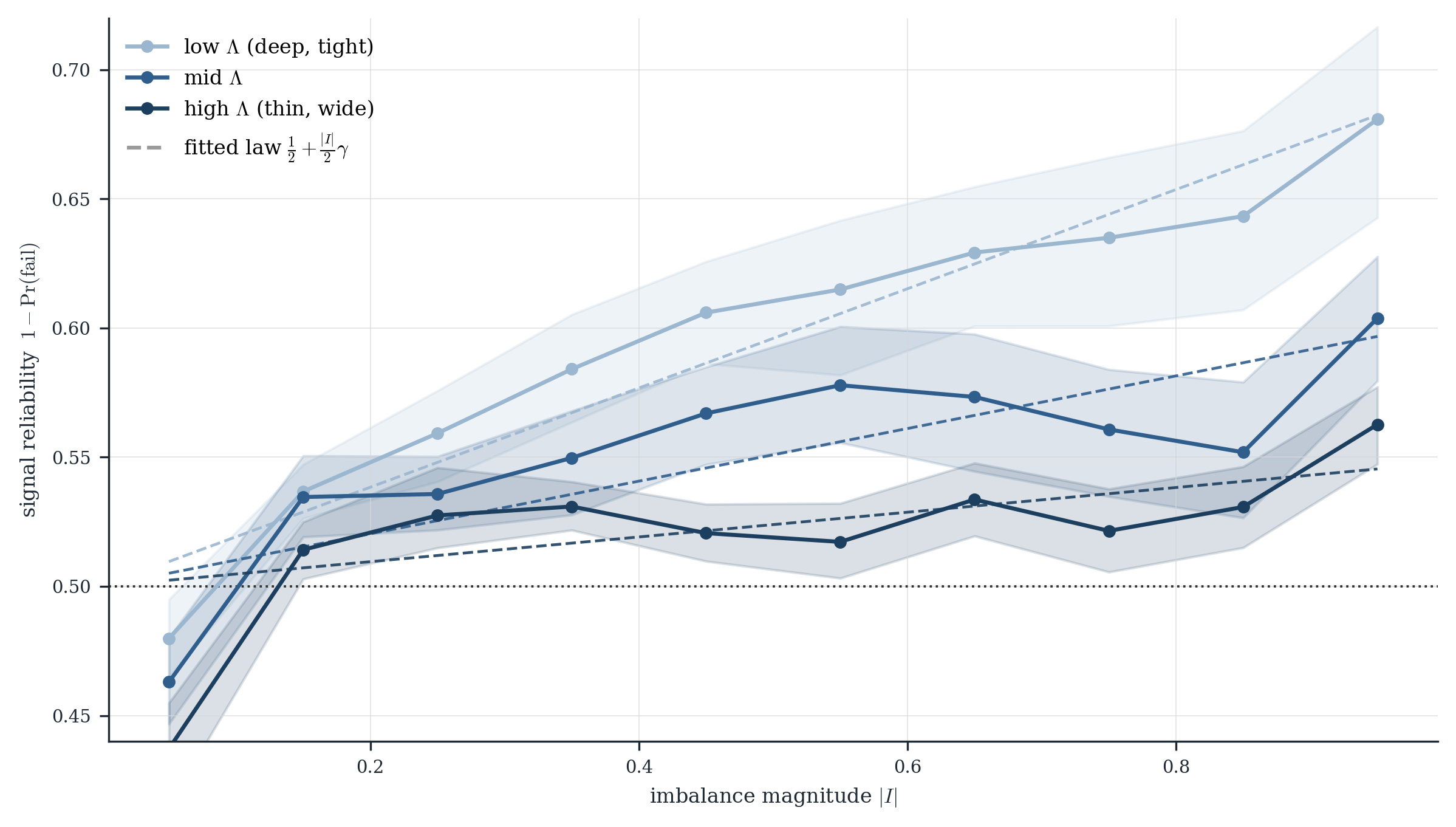
the reliability law (Proposition 1)
r(2p−1)−S/2=r∣I∣γ(s)−S/2
expected net payoff per acted trade (worthwhileness)
Figures
Fig 1. The diagnostic and its mechanism, on the QSE hold-out. Left: held-out AUC at the imbalance-failure event for each predictor, with instrument-clustered 95% intervals (39 instruments); book-geometry variables (imbalance magnitude |I|, inverse depth, the book-side ratio Λ = S/ν) discriminate, while realised volatility σ is weak and the order-flow measures (|OFI|, VPIN) are at chance. Right: the mechanism — the imbalance failure rate by |I| decile (37 instruments, H=20): the signal fails in balanced books (0.55 at the lowest decile) and holds in saturated ones (0.38 at the highest).Fig 2. The reliability law in the data. Signal reliability 1−Pr(fail) against imbalance magnitude |I|, split into within-instrument terciles of the book-side ratio Λ (low = deep and tight, high = thin and wide); solid lines are cross-instrument means with 95% bands (37 instruments), dashed lines the fitted law ½ + (|I|/2)·γ of Proposition 1. Reliability rises with |I| (the direction channel) and, at every |I|, falls as Λ rises (the noise channel).Fig 3. Economic reading of the selective-action result (an illustration, not a strategy backtest). On each held-out event a directional bet on the imbalance sign is booked, held H=20 events and netted of a half-spread crossing (40 instruments, 1.96M events). Left: mean net P&L per acted trade vs coverage for the Λ-gate, the volatility gate, and no gate; the Λ-gate preserves the most value at every coverage. Right: the Λ-gate's advantage over the volatility gate, net and gross, with 95% bands — positive at every partial coverage.
Full paper
This is a working paper. The full PDF is available on request — the replication code is public on GitHub.