// working paper · 2026
The Microdiffusion: Book-State Price Risk and Heavy Tails in Event Time
Evidence from the Qatar Stock Exchange
Abstract
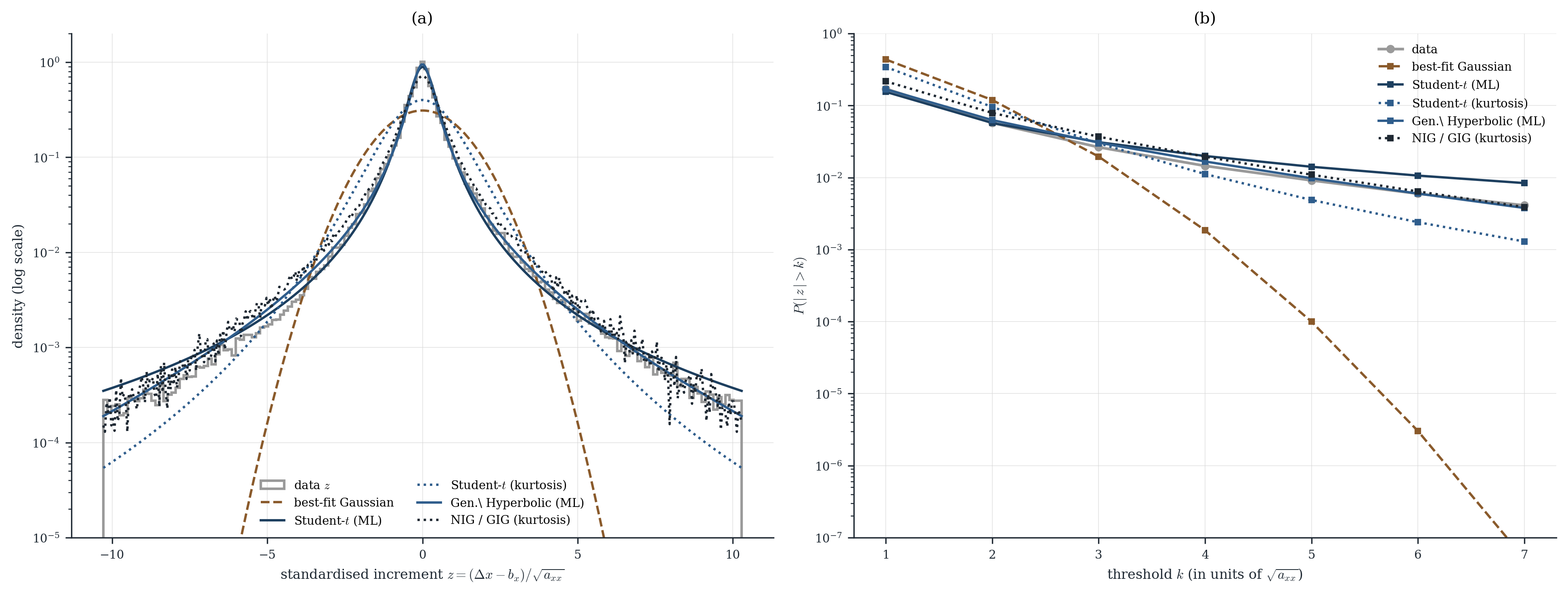
The visible limit order book is usually read as a signal of where the price will go next. This paper asks what it says about how far the price may go, in either direction. Using tick-by-tick data from the Qatar Stock Exchange, we estimate the microdiffusion, the conditional variance of the next mid-price move as a function of the quoted spread and the best-level imbalance, and we model the distribution of the move around that scale with a symmetric Generalized Hyperbolic innovation. The result is a conditional-variance and tail-risk model whose inputs are observable at the moment the forecast is made: the link between book state and scale is estimated from historical state and return pairs, so the current book conditions the forecast rather than revealing it outright.
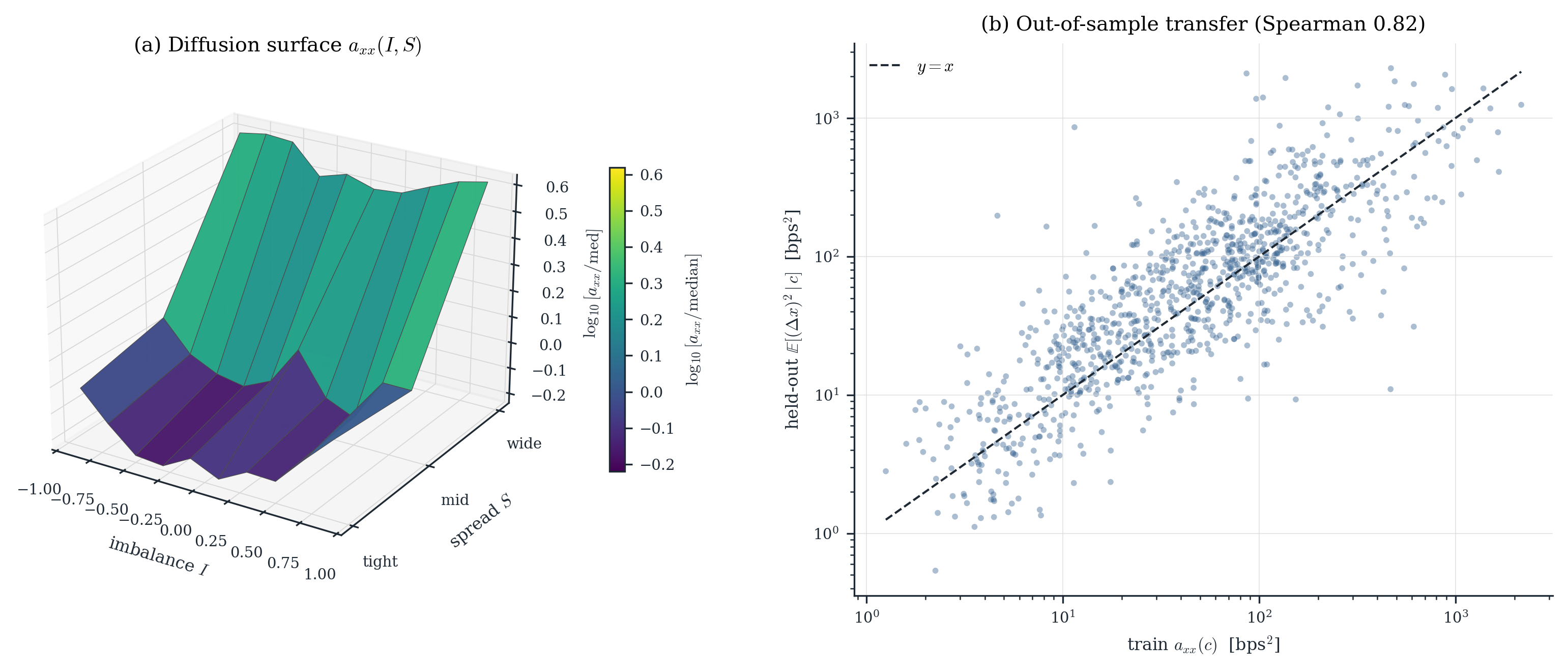
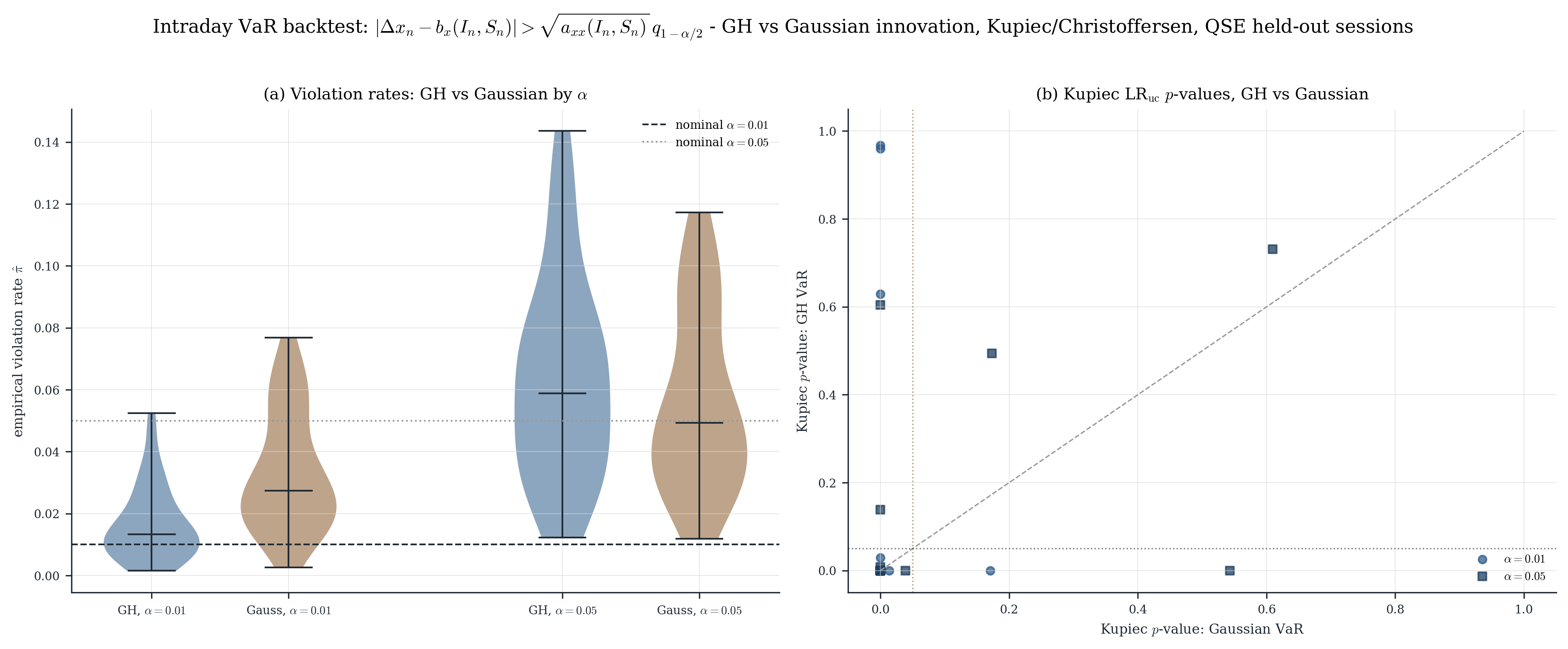
The estimated state-to-variance map is partially reproducible out of sample. Its ranking of book states persists on held-out days, the spread-driven level transfers across days, instruments, and volatility regimes, and the imbalance dimension raises conditional variance contemporaneously but transfers weakly as a shape. A nested comparison under strict forecast losses sharpens this division: the quoted spread carries essentially all of the one-step predictive content, both for the probability that the price moves at all and for the size of the move when it does. The heavy-tailed innovation then matters where variance models are weakest: it materially improves extreme-tail coverage in intraday value-at-risk backtests, and the model's predictive log score is statistically indistinguishable from a jointly estimated GARCH-t benchmark while clearly improving on its Gaussian version.
Core model
event-time stochastic equation for the mid-price move
the microdiffusion: conditional variance of the next move
event-time mean-square decomposition used for estimation
Figures
Full paper
This is a working paper. The full PDF is available on request — the replication code is public on GitHub.